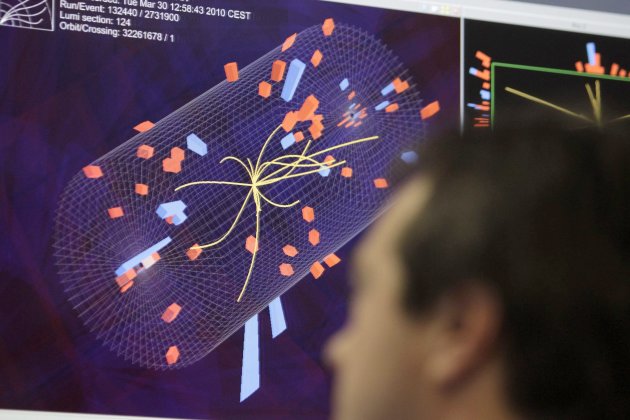
Higgs boson verified at Level 5 sigma signal at around 125 GeV????? Yowza.
OK, let's try this again: Scientists are now within reach of finding
the so-called God particle. About 5,000 researchers divided into two
teams--ATLAS and CMS--found a subatomic particle, and it could be the elusive Higgs, the polka-dotted unicorn of the physics world. Here's a "simple" explanation of what has physicists agog the world over:
As of July 4, 2012, the Higgs boson is the last
fundamental piece of the standard model of particle physics to be
discovered experimentally. But you might ask, why was the Higgs boson
included in the standard model alongside well-known particles like
electrons and protons and quarks, if they hadn't been discovered back
then in the 1970s? (The Higgs Boson, Part I, Minute Physics)
Wait, is this the simple explanation? Let's try this again,
because our decoder rings are telling us that scientists are on the
verge of discovering the mass behind matter, the be-all behind the
universe coming into being. And, if we're understanding these overly
intelligent mutterings, the applications of this finding has all sorts
of implications, like figuring out dark matter, time travel, and other
exhilarating-terrifying possibilities. So here's a layman's low-down on
Higgs boson and what it could mean for humankind.
I thought these animals were extinct? Not bison, but boson.
The name Higgs boson comes from a mash-up of two names: British
physicist Peter Higgs and an Indian scientist, whose underrated
accomplishments got a class of particles named after him.
[A] boson -- one of the two fundamental classes of
subatomic particles -- is named after Satyendra Nath Bose, who preceded
Higgs. ... Bose, who worked with Albert Einstein to bring out the
Bose-Einstein statistics and the theory of Bose-Einstein condensate in
the 1920s, was a natural candidate for a Nobel Prize, which he never
got. But his work on quantum mechanics was so substantial that one of
the subatomic particles was named after him. However, when science's
biggest find came, Bose was missing from the limelight, even in India.
(July 5, Times of India)
What does God have to do with this: Nobel Prize winner Leon
Lederman, who wanted to push the (expensive) idea of building the
Superconducting Super Collider in Texas, dropped the term in his 1993
book, "The God Particle: If the Universe Is the Answer, What Is the
Question?" The phrase came from his desire for a defining name that
would explain humankind's "final understanding of the structure of
matter."
Why God Particle? Two reasons. One, the publisher
wouldn't let us call it the Goddamn Particle, though that might be a
more appropriate title, given its villainous nature and the expense it
is causing. And two, there is a connection, of sorts, to another book, a
much older one. (July 5, Poynter)
Thanks for the etymology, what about the science? Here goes: A
20th-century breakthrough figured out that atoms were made up of three
particles: protons, neutrons, and electrons. Then, as physicists are
wont to do, they started smashing the particles, which broke down into
even smaller particles.
Scientists figured these itty-bitty particles were quarks, held
together by gluons. Then scientist Peter Higgs proposed the burning,
yearning question: Surely there must be one uber-particle that creates
an invisible field (called the Higgs field) that adds mass to matter.
After all, why do planets cluster around the sun?
As Higgs theorized things, the universe is filled with
an energy field through which all particles must move much the way an
airplane has to push its way through a stiff headwind. The greater the
potential mass of the particle, the greater the resistance it
encounters. It's theoretically possible for a particle to have no
actual mass at all, and indeed, the photon is massless. But that's the
exception. All other particles -- protons, electrons, neutrons,
neutrinos -- are eventually pinged by the Higgs bosons that suffuse the
field. That tiny collision converts the particle from a packet of
energy to a packet of matter. (The Higgs acquires its own mass through
its own interactions with the field.) (July 4, Time)
Higgs field is what's important: MSNBC's Cosmic Log, which does a manly job at a resource roundup,
updates a 1993 analogy to explain the Higgs field: You're on a balcony
watching a cocktail party. People come in and walk from one end of the
room to another. Then, Justin Bieber enters. Hysteria ensues --
partygoers cluster around him and he can barely move and get to the
cocktail franks at the other end of the room.
[O]nce he moves, the crowd moves with him in such a way
that the whole group is harder to stop. The partygoers are like Higgs
bosons, the just plain folks are like massless particles, and Bieber is
like a massive Z boson. (July 3, MSNBC)
Isn't everything simpler when Bieber's in the picture?
What's the big deal? Besides understanding how the universe works?
Discovering the so-called Higgs boson particle would be
one of the greatest achievements in science, rivaling the discovery of
the structure of DNA in 1953 and the Apollo moon landings of the 1960s
and 1970s. It can explain why some particles have mass, but why others,
such as photons of light, do not. ... A Higgs boson particle is
essential to the so-called standard model of physics -- the generally
accepted theory about how the universe works. Finding it would
effectively confirm the standard model. (July 5, Independent)
CERN researchers caution
that, "despite press reports, the Higgs is not directly related either
to the Big Bang or inflation -- as far as we know." That's not stopping a
lot of what-if scenarios. After all, the Web came about by CERN
scientists desire to give particle physicists quicker ways to commune.
The U.S. Department of Energy
lists the discipline for helping with eveything from food sterilization
and scanning shipping containers to cancer research and testing nukes.
Space.com thinks the particle could explain dark matter (although CERN researchers threw cold water on that one, too, telling Nature that "Higgs boson alone wouldn't really help much with the 'big' questions [dark matter, dark energy, etc].") ZeeNews ponders
that perhaps inertia (or drag) can be reduced in future technologies,
like a jumbo jet. Two Vanderbilt University theoretical physicists
propose a "long shot" pipe dream about time travel, but hey, isn't that the job of theoretical physicists?
Other things you didn't know but wanted to about Higgs boson:
—Higgs and the atom smasher: By the numbers (Live Science)
—Why scientists don't like the term 'God particle' for the Higgs boson (Christianity Today)
—CERN scientists inexplicably present Higgs boson findings in Comic Sans (The Verge)
—Hipster pop quiz: What is the Higgs boson (Motherboard, beware the foul mouths in Brooklyn)

No comments:
Post a Comment