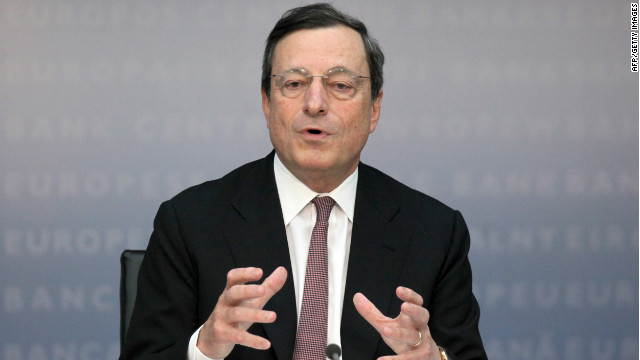
- The ECB's president has awakened hopes that it could act more decisively in the economic crisis
- Mario Draghi said the ECB is "ready to do whatever it takes" within its mandate
- He suggested the ECB had a remit to react to high spreads on sovereign debt
- He hinted that it could act once more to buy the bonds of struggling countries
(Financial Times) -- Dealing with surging yields on the debt of some eurozone governments is "part of the mandate" of the European Central Bank, its president Mario Draghi has said in comments that awakened market hopes that the ECB could act more decisively in the region's economic crisis.
The euro strengthened on Thursday after Mr Draghi said the ECB was "ready to do whatever it takes" within its mandate to preserve the single currency. "Believe me, it will be enough," Mr Draghi told a conference in London.
The bonds of struggling eurozone countries including Spain and Italy also gained in price, bringing yields down, as Mr Draghi suggested that the ECB had a remit to react to high spreads on sovereign debt if they interfered with the central bank's monetary policy -- its prime tool for fulfilling its main job of price stability.
Countries such as Spain have seen the spreads on their bonds -- that is, what they have to pay to borrow over and above what it costs a benchmark issuer such as Germany -- soar as fears have grown that they will struggle to shore up their ailing budgets.
Spain's government has called for the ECB to reactivate a dormant programme of buying sovereign bonds to try to drive down yields.
Mr Draghi and other ECB policy makers have appeared reluctant to buy more bonds, suggesting it could instead be done by bailout funds pledged during the crisis by eurozone governments.
The ECB's policy of buying bonds, even on secondary markets, has been controversial because some of its officials believe it brings the central bank too close to direct financing of eurozone member states, which it is not allowed to do.
But in saying that excessive bond spreads were something the central bank could address, Mr Draghi hinted that the ECB could act once more to buy the bonds of struggling countries.
"To the extent that these premia have to do not with factors inherent to my counter party, they come into our mandate, they come within our remit, Mr Draghi said. "To the extent that the size of the sovereign premia hamper the functioning of the monetary policy transmission channels, they come within our mandate."
Mr Draghi's comments caused a strong rally in the bonds of Italy and Spain, and the euro to jump the most against the dollar in more than a month.
Spain's benchmark 10-year bond yield fell 35 basis points to 6.93 per cent and Italy's comparable benchmark government bond yield declined 33 bp to 6.06 per cent.
The rally was even more marked in shorter-dated government bonds of the two embattled countries. Spain's two-year bond yield fell 62 bp to 5.55 per cent, and Italy's by 54 bp to 4.34 per cent.
Ken Wattret of BNP Paribas said Mr Draghi's comments were a "clear reference to the potential for restarting" the buying of bonds, which the ECB calls its securities markets programme.
"The ECB appears to be keen to increase the threat of the SMP being woken from its hibernation period," Mr Wattret wrote in a note. "Are the latest comments a signal that the ECB's strategy is changing and the SMP is about to be used? Or is it merely a threat to act, designed to put some two-way risk back into markets?
"Our inclination is towards the latter conclusion, though today's comments from Mr Draghi suggest the former now looks more plausible."
The comments from the ECB president may also increase speculation about other "unconventional" measures the central bank could take. This week Ewald Nowotny, head of Austria's central bank, said there were arguments for equipping the eurozone's forthcoming bailout fund with a banking licence so it could tap the ECB for more funds if needed -- although he also said the idea was not being actively discussed by the ECB.

No comments:
Post a Comment