Showing posts with label CNN Money. Show all posts

Sunday, October 7, 2012

China's epic traffic nightmares


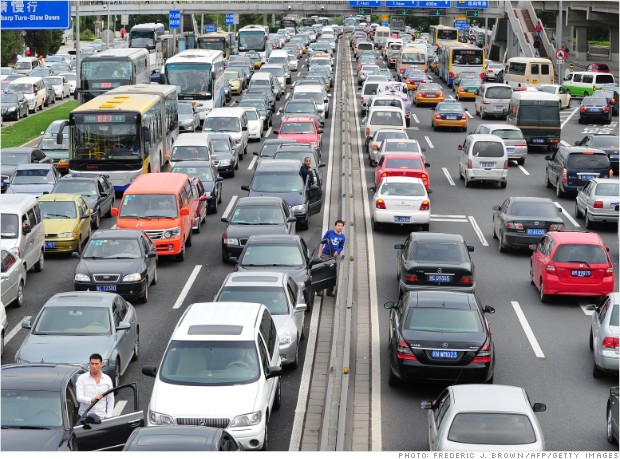
Drivers check for a better view during "Car Free Day" in Beijing.


More people live in China than any other country, and in 2010 it surpassed the United States as the largest car market on Earth. As the popularity of automobiles grows, China's infrastructure has struggled to keep pace.


The result is -- like anywhere else in the world -- traffic jams.


Yet traffic jams in China are not always brief hiccups during the evening commute. In fact, the worst jams in China, while rare, can last for days.


Source & Image : CNN Money

The stock market rally is over


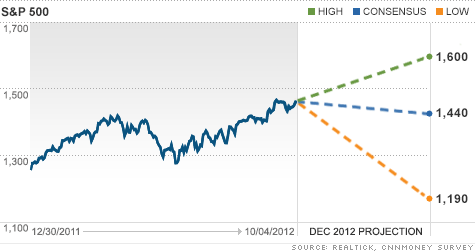
The S&P 500 will finish 2012 at 1,440, up a healthy 15% for the year but in the exact same spot where it started the fourth quarter, according to an exclusive CNNMoney survey.


NEW YORK (CNNMoney) -- Despite a slowing global economy, political and fiscal uncertainty and ongoing turmoil in Europe, the U.S. stock market has delivered quite the performance this year, thanks in large part to stimulus efforts by the world's central banks.


But experts believe the robust gains are now remnants of the past. In fact, according to an exclusive CNNMoney survey of 37 investment strategists and money managers, the S&P 500 will finish 2012 at 1,440, up a healthy 15% for the year but in the exact same spot where it started the fourth quarter.


"I'm not suggesting for anyone to get out of their equity positions, but our view is that most of the gains for the year are behind us," said Cetera Financial Group markets strategist Brian Gendreau, whose year-end target for the S&P 500 stands at 1,450.


The reason for the stagnation? According to the strategists and money managers surveyed by CNNMoney, there are a number of hurdles putting downward pressure on stocks.


CNNMoney survey: Where the markets are headed in 2012


The first major obstacle is the Nov. 6 presidential election. Leading up to that day, stocks will likely trade in a narrow range, as everyone from policymakers to investors is holding his or her breath, said Jack Ablin, chief investment officer at Harris Private Bank, who is also predicting the S&P 500 will end the year at 1,450.


Once the White House winners have been declared, volatility will only increase as the next hurdles pop up.


"After the elections, lawmakers will have to face the fiscal cliff, and they only have a handful of days to debate and pass new legislation before the end of the year," said Oliver Pursche, president of Gary Goldberg Financial Services, who expects the S&P 500 to finish the year at 1,435.


Individual investors miss the rally ... again


Congress has until midnight on Dec. 31 to prevent a series of tax cuts from expiring, and to keep funding intact for hundreds of federal programs. As long as Congress remains noncommittal about how to avert the fiscal cliff, "at best, it will be a turbulent time for the markets," said Pursche.


Headlines out of Europe will also add to the volatility, said Gendreau.


While the political and economic uncertainty that's currently plaguing the United States and Europe would typically trigger a market sell-off, experts say intervention from the European Central Bank and the Federal Reserve have been helping keep markets afloat -- though it's not enough to keep the rally going.


"All the liquidity they're slushing out is keeping a floor underneath the market," said Pursche. "As a result, we're not expecting to see a material decline in stocks. But we also don't foresee any catalyst that could propel the market significantly higher."


Source & Image : CNN Money

Cancer launched my business


David Luks, Honeydrop Beverages


David Luks, 37: Cancer was a wakeup call to redefine meaning of "healthy."


Revenue:
$3.5 million


David Luks, founder and CEO of Honeydrop Beverages, remembers the day -- April 20, 2006 -- when he was diagnosed with testicular cancer.


"It was completely out of the blue. I was recently married, active and perfectly healthy," said Luks.


A regular checkup had led to his diagnosis of early-stage testicular cancer. "I was lucky. It was caught early and the tumor was removed," he said.


Cancer was a wakeup call to redefine his "definition of healthy."


As a longtime Pepsico (PEP, Fortune 500) marketing executive, Luks knew the food business at a high level and started researching the benefits of organic and natural foods.


"I read that honey is a natural antioxidant, an unrefined sweetener, and that it's clinically better for your throat than over-the-counter medication," said Luks.


In 2009, using his personal savings and credit cards, Luks launched Honeydrop Beverages, a line of low-calorie teas and juices sweetened with unrefined honey.


"I told myself that you only live once," he said. "I wanted to experience what it was like being an entrepreneur."


Today, his New York-based company has seven employees. His drinks are sold in Whole Foods and other natural foods stores nationwide.


Source & Image : CNN Money

Stocks: Investors anxious about earnings


Click chart for more markets data


NEW YORK (CNNMoney) -- Investors are on pins and needles ahead of the start of third-quarter earnings season.


As always, aluminum manufacturer Alcoa (AA, Fortune 500) will kick off the fall season when it reports results after the closing bell Tuesday.


A host of companies have already revised their financial estimates down. But next week, as companies including Yum! Brands (YUM, Fortune 500), Costco (COST, Fortune 500), Safeway (SWY, Fortune 500) and Infosys (INFY) announce results, will offer the first clear picture of just how hard the global economic slowdown has hit business revenues and profits.


"These earnings are going to set the tone for what earnings season will look like overall," said Ben Halliburton, managing director at Tradition Capital Management. "We seem to be seeing some of the worst pre-announcements coming out since we did in 2008."


Investors are worried that a disappointing earnings season could cause the 2012 stock market rally to fizzle. The S&P 500, the Dow and the Nasdaq are all up more than 11% this year. Stocks ended the week up roughly 1%.


Related: September jobs report: Unemployment rate tumbles


Negative earnings were counterintuitively viewed as a good thing by investors recently because they were perceived as ammunition for another round of bond buying by the Federal Reserve. With QE3 already in the cards, bad earnings will likely be viewed as simply bad earnings.


"Since June, we've had very much of a Fed-induced rally. People said 'oh, the economy is slowing, the Fed will help,'" said Halliburton. "If earnings come out negative, where do we go from here?"


On Friday ahead of the open, JPMorgan Chase (JPM, Fortune 500) and Wells Fargo (WFC, Fortune 500) will be the first two banks to report. These banks will give investors a sense of whether lending has picked up and provide color on the strength of a housing recovery.


Related: Bank profits rebounded in third quarter


JPMorgan's Jamie Dimon will also be forced to confront the elephant -- or should we say, the London Whale -- in the room.


Dimon has indicated that traders have tamed the outsize losses from the bank's big bets on derivatives, but investors are still wondering whether the $5.8 billion loss has increased since the bank's second-quarter earnings call.


The spate of earnings reports may finally give investors a week-long breather from watching every move made by European leaders and central bankers. The main focal point this week in Europe is a meeting among finance ministers Monday evening to discuss Greece and Spain. Analysts and investors aren't expecting any concrete plans to come from those meetings. The primary summit for European leaders will be held the following week.


In additional to earnings, U.S. investors will continue to get more economic reports, following a stellar and surprising report on employment. Readings on consumer and producer inflation rates will be released. The Federal Reserve will also release its beige book on Wednesday, a report on economic activity in 12 key regions.


Source & Image : CNN Money

Saturday, October 6, 2012

Jack Welch questions jobs numbers


NEW YORK (CNNMoney) -- The big drop in the unemployment rate a month before the presidential election brought cries of disbelief and conspiracy theories from Jack Welch and other critics of the Obama administration Friday. But the Labor Department was quick to dismiss such claims.


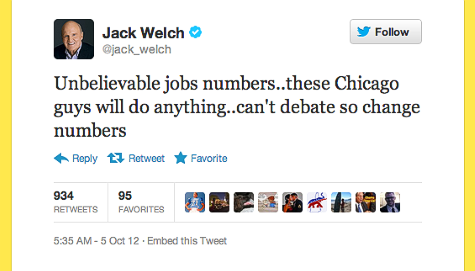
"Unbelievable jobs numbers..these Chicago guys will do anything..can't debate so change numbers," tweeted Welch, the former CEO of General Electric (GE, Fortune 500).


Welch did not respond to a request for further comment. In an interview later in the day on MSNBC, he admitted that he had no evidence that the jobs numbers were manipulated, but said they "defy logic."


The unemployment rate fell to 7.8% in September, down from 8.1% a month earlier. The drop was due to the Bureau of Labor Statistics' survey of households showing that 873,000 more people had jobs than in the previous month. That was the biggest one-month gain in more than nine years.


Labor Secretary Hilda Solis criticized the conspiracy theories Friday.


"This is a methodology that's been used for decades. And it is insulting when you hear people just cavalierly say that somehow we're manipulating numbers," Solis told CNN's Richard Quest.


Welch wasn't alone in raising questions about the jobs numbers.


Americans for Limited Government, a conservative group that has been a steady critic of the Obama administration, issued a statement that said the numbers the BLS "used to calculate the unemployment rate are wrong, or worse manipulated. Given that these numbers conveniently meet Obama's campaign promises one month before the election, the conclusions are obvious. Anyone who takes this unemployment report serious is either naive or a paid Obama campaign adviser."


iReport: Are you reluctantly taking a part-time job?


Conn Carroll, a senior writer at the conservative Washington Examiner suggested a slightly less nefarious form of manipulation of the data.


"I don't think BLS cooked numbers. I think a bunch of Dems lied about getting jobs. That would have same effect," he tweeted. "Would love to see the partisan breakdown of the 873,000 Americans who say they got new jobs."


Related: Unemployment rate tumbles


BLS denied there was any manipulation of the data or anything out of the ordinary about the unemployment rate calculation.


"No political appointee is involved in the collecting, processing and analyzing of the data," said Thomas Nardone, the associate commissioner for employment and unemployment statistics.


Nardone said the Council of Economic Advisers doesn't get the numbers until Thursday afternoon, and that the Secretary of Labor he rself doesn't see them until Friday morning.


Related: GE's Immelt - U.S. starved for investment


Even some conservative economists defended the BLS's integrity and legitimacy of the numbers.


"The jobs #'s may look fishy to some, but if you step back, it's just a plow horse economy lumbering along," tweeted Brian Wesbury, chief economist at First Trust.


Source & Image : CNN Money

Friday, October 5, 2012

Foxconn workers strike over iPhone 5 demands, labor group says


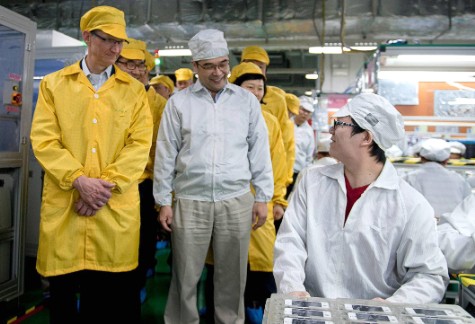
Apple CEO Tim Cook visited Foxconn's Zhengzhou factory in March, months before Friday's report of a massive strike at the plant's iPhone 5 production lines.


NEW YORK (CNNMoney) -- Thousands of factory workers at Foxconn went on strike Friday to protest their working conditions on the iPhone 5's production lines, according to a report from an independent workers' rights organization.


Workers at Foxconn's plant in Zhengzhou, China, were furious after management enacted "overly strict demands" for production of Apple's (AAPL, Fortune 500) new iPhone 5, according to a report late Friday from China Labor Watch (CLW), a New York-based advocacy group that works closely with sources in China.


The strike began at 1 p.m. local time (1 a.m. ET) on Friday, CLW said, and the majority of its participants were from the on-site quality control line for the iPhone 5. It remained ongoing into the evening, causing a work stoppage that "paralyzed the production lines," the group said.


Foxconn did not respond to emailed requests for comment that were sent after normal business hours at its Chinese headquarters. Apple also did not respond to a request for comment.


The trouble began after workers were given new, impossibly strict standards, demanding precision down to increments as small as two-hundredths of a millimeter, according to CLW.


"Employees could not even turn out iPhones that met the standard," CLW's report said, because of "design defects" in the iPhone 5.


Foxconn's exacting demands, coupled with the fact that workers were not allowed to take vacation time during a recent week-long holiday, created a high-pressure situation. Workers and inspectors clashed in fights that sometimes turned physical, the CLW said, with some hospitalized as a result.


Foxconn's Zhenghou complex employs around 190,000 people, according to CNET, which recently visited the area. Apple CEO Tim Cook made an appearance at the plant in March.


CNNMoney spoke to U.S.-based staffers at CLW, which is a frequently cited source for Western media outlets reporting on Chinese labor issues.


Bessie Chang, a CLW program assistant, said it was the organization's Chinese-based staff that first heard rumors of the strike. CLW director Li Qiang spoke to his sources at Foxconn to verify the report.


Qiang, speaking through Chang as a translator, said the strike continued as of 11 p.m. local time (11 a.m. ET) Friday. He hasn't received information since then, but he noted that Foxconn production lines typically run 24 hours a day. He did not know whether workers on every shift are participating in the strike.


Foxconn has been in the spotlight amid growing public concern about labor conditions in the overseas factories that many U.S. gadget makers rely on to produce their devices. Apple is just one of many companies that outsources its manufacturing, but as the industry's most popular and profitable company, it's under the most intense scrutiny.


A spate of suicides at Foxconn factories in 2010 garnered media coverage of allegedly harsh working conditions, including unsafe facilities and illegal amounts of overtime.


In January 2012, Apple joined the dependent labor-rights organization Fair Labor Association (FLA), which promptly began inspections of the working conditions at Foxconn's many factories.


FLA released an assessment in March that documented dozens of major labor-rights violations, including excessive overtime, unpaid wages and salaries that aren't enough to cover basic living expenses. The FLA's report said Foxconn agreed to work with the group on improvements, including enacting "full legal compliance" with Chinese work-hour laws by July 2013.


Last month, a large-scale incident involving 2,000 workers forced the temporary closure of Foxconn's Taiyuan factory. One worker at the scene termed the situation a riot, and it led to the hospitalization of about 40 people.


Source & Image : CNN Money

5 best conspiracy theories debunking the jobs report

It's all made up! And more conspiracy theories from around the web.


FORTUNE – The latest jobs numbers released Friday morning were a pleasant surprise to many Americans. For the first time since President Obama took office, the unemployment rate fell below 8%, but Jack Welch, former General Electric CEO (and Fortune contributor), wasn't at all convinced. Welch quickly took to Twitter to accuse the Obama team of manipulating the newly released numbers, following a U.S. presidential debate. "Unbelievable jobs numbers .. these Chicago guys will do anything .. can't debate so change numbers," he tweeted.


Welch's tweet has gone viral, prompting plenty of others to banter about their own conspiracy theories that the jobs report is somehow manipulated.  Here's a look at a few:


Obama has hired infamous Iraqi Information Minister Baghdad Bob to calculate the unemployment rate: This was from the self-described non-partisan group, Americans for Limited Government, which released a statement saying that Friday's unemployment report was downright unbelievable. "It appears that Obama has hired infamous Iraqi Information Minister Baghdad Bob to calculate the unemployment rate. Anyone who takes this unemployment report serious is either naïve or a paid Obama campaign adviser," says Americans for Limited Government Communications Director Rick Manning, also former Public Affairs Chief of Staff at the U.S. Department of Labor.


Democrats lied about getting jobs: Not all agree with Welch that the numbers were cooked, but that isn't to say they weren't somehow manipulated. Washington Examiner writer Conn Caroll tweeted on Friday that "I don't think BLS cooked numbers. I think a bunch of Dems lied about getting jobs. That would have the same effect."


Obama is learning from Saul Alinsky: Rep. Allen West (R-Fla.) stood by Welch, posting comments on his Facebook page that jobs numbers have been cooked and reflect manipulative tactics from the left: "This is Orwellian to say the least and representative of Saul Alinsky tactics from the book "Rules of Radicals" – a must read for all who want to know how the left strategize."


Obama spends more time lobbying Labor Department than campaigning: As Welch has implied, Obama tweaked the jobs numbers coming off a presidential debate. And so many in the twittersphere have wondered if the president has been spending more time lobbying the Bureau of Labor Statistics, which compiles the jobs data, than campaigning.


Source & Image : CNN Money

September jobs report: Unemployment rate tumbles


NEW YORK (CNNMoney) -- Friday's monthly jobs report changed the picture of the U.S. economy in more ways than one, showing the unemployment rate fell to the lowest level in more than three years and hiring was stronger than originally reported throughout the summer.


Unemployment unexpectedly fell to 7.8% in September, down from 8.1%, as a survey of U.S. households showed 873,000 more Americans had jobs compared to a month earlier.


The last time the unemployment rate was that low was in January 2009, the month President Obama was inaugurated.


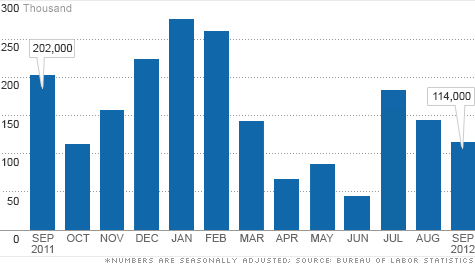
A separate survey of employers, considered the key metric that Wall Street watches, showed businesses added 114,000 jobs in September. It marked a slowdown in hiring, after July and August were revised significantly higher.


Those revisions added 86,000 more jobs than originally reported in the summer. Stocks rose in morning trading.


Ever since the financial crisis, the monthly jobs report has been the most intensely watched economic indicator, but in election season, attention surrounding the numbers has reached new heights.


Related: Fiscal cliff threatens 277,000 federal jobs


The Labor Department collects the data monthly, using both a survey of employers and a smaller survey of households. The two surveys don't always tell the same story on the first read, but over time, the data is revised to reflect more comprehensive information.


In the most recent household survey, the biggest hiring gains came in the form of 582,000 new part-time jobs in September. Part of that number can be explained by young workers, ages 16 to 24. The data show this age group saw a huge pickup in jobs in September, due almost entirely to seasonal adjustments by the Labor Department.


Meanwhile, the employer survey showed the health care sector added 43,500 jobs, transportation and warehousing added 17,100 jobs and restaurants and bars added 15,700 jobs. Manufacturers cut 16,000 jobs -- the second month in a row they've slashed workers.


The government added jobs for the third month in a row.


Commentators from both sides of the political spectrum were quick to jump on the numbers Friday morning as both a sign that the job market has improved recently, and that economic growth remains far too slow to pull millions of Americans out of unemployment.


Both points are correct.


Did you get a job? Tweet us #igotajob


Although the unemployment rate is right back to where it was when Obama entered office, the U.S. economy has still not recovered all the jobs lost before his inauguration.


Of the 8.8 million jobs cut during the recession, about 4.3 million have been added back. The Labor Department signaled last week that it may revise the job gains higher, but even so, the job market still has a long way to go before it's fully healed.


About 12.1 million people were unemployed in September, and 40% of them have been so for six months or more.


The so-called "underemployment rate," which includes people who are working part time for economic reasons, and those who have recently dropped out of the labor force, was 14.7% in September.


Did you recently find a job? Tweet @CNNMoney using the #igotajob hashtag, and you could be featured in an upcoming article.


Source & Image : CNN Money

Entrepreneurship is 'weaker than ever'


NEW YORK (CNNMoney) -- Despite glimmers of good news for job creation, the state of America's startups presents a troubling sign: There are fewer of them, and those that exist are hiring fewer workers.


It's a one-two punch that poses a serious threat to the workforce, because studies have shown that startups are America's true job creators.


Historically, new companies have generated 3 million net new jobs every year. That fell to 2.5 million during the recession, and recent government figures suggest it's only gotten worse.


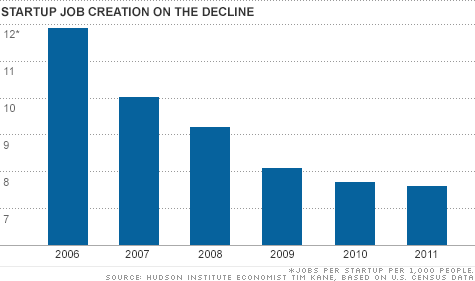
As for how many jobs they create, Tim Kane, an economist at the Hudson Institute, found a sharp decline.


Related: 9 hot businesses you can start now


Using data from the Labor Department, Kane looked at how many startup jobs were created for every 1,000 people. In the 1980s and 1990s, it held steady at about 11. Kane's estimates show that in 2010 and 2011, it dropped below 8.


"The state of entrepreneurship in the United States is, sadly, weaker than ever," he said in the report.


What's causing the decline? The report doesn't say for certain, although there are some clues.


Local regulations have steadily become a growing barrier for entrepreneurs. Opening a barber shop or a day spa isn't what is used to be. City officials, local boards and state governments have ratcheted up regulation and demanded entrepreneurs get licenses to operate.


It's an issue that Kauffman Foundation scholar Brink Lindsey points out in his book, Human Capitalism. He says the burden is destroying opportunities for entrepreneurs in the lower and middle classes.


Meanwhile, workers in the United States are more frequently competing on the global stage. To new companies that don't need employees in the office, it's often cheaper to hire freelancers in less developed nations than hire American workers. Kane said hiring someone abroad requires less paperwork and costs less in taxes.


Related: Obama's tax plan catches small employers too


Online services, like Elance, connect companies with freelancers around the world. By making it easier for companies to post jobs -- and hire independent workers to take them -- it's greasing the axles.


But Kane doesn't object to Elance's service. Instead, he argues that government hiring obstructions on employers must be lifted.


"I'm worried the environment is pushing jobs overseas at a micro level," Kane said. "I don't know the answers, but we need to know it exists."


Source & Image : CNN Money

Jack Welch: Unemployment rate cooked


NEW YORK (CNNMoney) -- The big drop in the unemployment rate a month before the presidential election brought cries of disbelief and conspiracy theories from Jack Welch and other critics of the Obama administration Friday. But the Labor Department was quick to dismiss such claims.


"Unbelievable jobs numbers..these Chicago guys will do anything..can't debate so change numbers," tweeted Welch, the former CEO of General Electric (GE, Fortune 500).


The unemployment rate fell to 7.8% in September, down from 8.1% a month earlier. The drop was due to the Bureau of Labor Statistics' survey of households showing that 873,000 more people had jobs than in the previous month. That was the biggest one-month gain in more than nine years.


Welch wasn't alone in raising questions about the jobs numbers. Americans for Limited Government, a conservative group that has been a steady critic of the Obama administration, issued a statement that said the numbers the Bureau of Labor Statistics "used to calculate the unemployment rate are wrong, or worse manipulated. Given that these numbers conveniently meet Obama's campaign promises one month before the election, the conclusions are obvious...Anyone who takes this unemployment report serious is either naive or a paid Obama campaign adviser."


Conn Carroll, a senior writer at the conservative Washington Examiner suggested a slightly less nefarious form of manipulation of the data.


"I don't think BLS cooked numbers. I think a bunch of Dems lied about getting jobs. That would have same effect," he tweeted. "Would love to see the partisan breakdown of the 873,000 Americans who say they got new jobs."


Related: Unemployment rate tumbles


BLS denied there was any manipulation of the data or anything out of the ordinary about the unemployment rate calculation.


"No political appointee is involved in the collecting, processing and analyzing of the data," said Thomas Nardone, the associate commissioner for employment and unemployment statistics. He said the Council of Economic Advisers doesn't get the numbers until Thursday afternoon, and that the Secretary of Labor herself doesn't see them until Friday morning.


Related: GE's Immelt - U.S. starved for investment


Even some conservative economists defended the BLS's integrity and legitimacy of the numbers.


"The jobs #'s may look fishy to some, but if you step back, it's just a plow horse economy lumbering along," tweeted Brian Wesbury, chief economist at First Trust.


Source & Image : CNN Money

Individual investors have insatiable appetite for ETFs


CHICAGO (CNNMoney) -- Individual investors' appetite for exchange traded funds is growing stronger.


In fact, more than 80% of 1,000 U.S. investors surveyed by Charles Schwab agreed that ETFs are "here to stay," and over 40% said they plan in invest in more ETFs during the course of the next year.


The survey also showed that more than half of those who have employer-sponsored retirement accounts, such as 401(k)s, would like to have ETFs as investment options.


In particular, those surveyed said they're most interested in buying ETFs that allow them to gain exposure to certain sectors, particularly, energy, health care and technology, as well as international markets.


ETFs were initially pitched to institutional investors when they hit the shelves about 20 years ago, but a growing number of individual investors have been jumping on the bandwagon since ETFs are often cheaper and more tax friendly than traditional mutual funds, and allow investors to easily diversity their portfolio, said Michael Iachini, head of ETF research at Charles Schwab Investment Advisory.


Related: Individual investors miss the rally...again


But while their interest is growing, individual investors admitted they still have a lot of questions about ETFs and how they work.


In fact, more than a third of those who already own ETFs in their portfolio consider themselves to be "novices" when it comes to ETF knowledge, according to the survey.


Although one reason investors turn to ETFs is for tax benefits, 44% of those surveyed said the top issues they want to learn more about are the exact tax implications associated with owning ETFs.


"Investors clearly don't feel like they know as much as they want to about investing in ETFs," said Iachini. "But they're learning, and we're making progress and moving in the right direction."


Source & Image : CNN Money

September jobs report: Unemployment rate tumbles


NEW YORK (CNNMoney) -- The unemployment rate tumbled in September as more people returned to the labor force and steady hiring continued.


Employers added 114,000 jobs during the month, down from a revised 142,000 jobs in August, the Labor Department said Friday. But revisions to July and August mean the economy added 86,000 more jobs than originally reported in those months.


Meanwhile, the unemployment rate unexpectedly fell to 7.8% in September, from 8.1% the prior month.


Although the revisions were positive, the economy is growing at the same sluggish pace it has been since the spring, and is showing few signs of speeding up any time soon.


The country generally needs at least 150,000 new jobs each month just to keep up with population growth.


Related: Obama's tax plan aims at rich, but catches small employers too


Most economists predict the U.S. economy will grow no faster than 3% a year, until at least 2014.


That's hardly fast enough to recover all the jobs lost since 2007. Of the 8.8 million jobs cut during the recession, about 4.3 million have been added back. The Labor Department signaled last week that it may revise the job gains higher, but even so, the job market still has a long way to go before it's fully healed.


About 12.1 million people were unemployed in September, and 40% of them have been so for six months or more.


Did you recently find a job? Tweet @CNNMoney using the #igotajob hashtag, and you could be featured in an upcoming article.


Source & Image : CNN Money

September jobs report: Unemployment rate tumbles


NEW YORK (CNNMoney) -- The unemployment rate tumbled in September as more people returned to the labor force and steady hiring continued.


Employers added 114,000 jobs during the month, down from a revised 142,000 jobs in August, the Labor Department said Friday. But revisions to July and August mean the economy added 86,000 more jobs than originally reported in those months.


Meanwhile, the unemployment rate unexpectedly fell to 7.8% in September, from 8.1% the prior month.


Although the revisions were positive, the economy is growing at the same sluggish pace it has been since the spring, and is showing few signs of speeding up any time soon.


The country generally needs at least 150,000 new jobs each month just to keep up with population growth.


Related: Obama's tax plan aims at rich, but catches small employers too


Most economists predict the U.S. economy will grow no faster than 3% a year, until at least 2014.


That's hardly fast enough to recover all the jobs lost since 2007. Of the 8.8 million jobs cut during the recession, about 4.3 million have been added back. The Labor Department signaled last week that it may revise the job gains higher, but even so, the job market still has a long way to go before it's fully healed.


About 12.1 million people were unemployed in September, and 40% of them have been so for six months or more.


Did you recently find a job? Tweet @CNNMoney using the #igotajob hashtag, and you could be featured in an upcoming article.


Source & Image : CNN Money

Obama's economy: A snapshot

Job growth
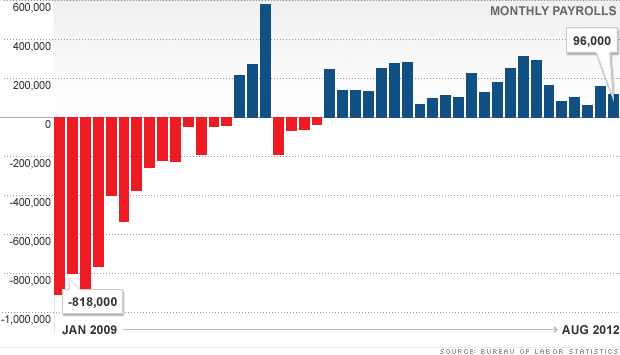
Job losses peaked in early 2009, and steadily declined throughout the year. The economy finally started creating jobs in the beginning of 2010, but then employers pulled back in the summer. A similar trend occurred in 2011, and then again in 2012, when strong momentum early in the year stumbled in the spring.


Source & Image : CNN Money

$4 gas: Get used to it

A new U.N. report says the massive bets placed on the commodities markets are the "root cause" of the volatility in oil and gas prices. And that's not about to change.


By Leah McGrath Goodman


gas-pricesFORTUNE -- President Obama may have a lot more to worry about than bombing the debate this week. Traders are starting to get particularly bullish over gasoline prices – and that is bad news for the average driver, who may also be looking to vent his spleen at the voting booth.


Reports of gas shortages along the high-demand west and east coasts may be fleeting – although deeply concerning – but they highlight a problem that's expected to persist in the U.S.: our refineries are getting old. Given that a new refinery has not been built since 1976, commodities desks on Wall Street are bracing for more refinery outages and fires just as the nation needs to gear up for the busy winter heating season.


MORE: Fact check: Obama isn't killing small banks


What does that mean? Probably more weeks where we'll see U.S. crude oil inventories hovering above the upper limit of the average range for this time of year, yet gasoline inventories tunneling into the lower half of their average range, as the U.S. Energy Information Administration reported Wednesday.


Translated in dollars and cents, retail gas prices likely won't be moving off the $4 needle anytime soon. In fact, some gasoline buyers think this may even usher in a run to $5 a gallon (especially out west where gas stations are shutting down because they cannot buy gas at price levels low enough to turn a profit).


The firmness in gasoline also is giving oil prices a boost, the knock-on effects of which cannot be understated.


Oil price spikes and consumer prices have been "highly correlated" over the past decade, according to the EIA, the nonpartisan statistics branch of the U.S. Department of Energy. The upshot? Americans are increasingly grappling with unchanged paychecks in the face of higher energy prices. Their money is buying them less, the EIA says, citing the Bureau of Labor Statistics' Chained Consumer Price Index.


MORE: Mitt Romney keeps Solyndra canard alive


Meanwhile, the U.N. recently released a report stating definitively that the "financialization" of commodities markets – or "hundreds of billions of dollars of bets placed on expectations of temporarily rising prices" for energy, food and metals products – is the "root cause" of the today's price volatility.


A key highlight of the U.N. report touched on how global oil prices this past summer were 65% higher than the averages reached during the commodity price boom of 2003 to 2008 (the period of the latest Iraq war to the Bush-era high near $150 a barrel). "Investors treat commodities as an asset class, which means that they are betting on a certain price trend during the period they are invested in commodity assets," the U.N. said. "They do not trade systematically on the basis of fundamental supply and demand relationships in single markets, even if shocks in those markets may influence their behavior temporarily."


Of course, when supply shocks do happen to dovetail with bullish bets – as is happening now – that's when oil and gas prices really take off. Perhaps it's no coincidence that the first presidential debate was sponsored by ExxonMobil (XOM).


Source & Image : CNN Money

Stocks: Eyes on jobs


Click on chart for more premarkets data.


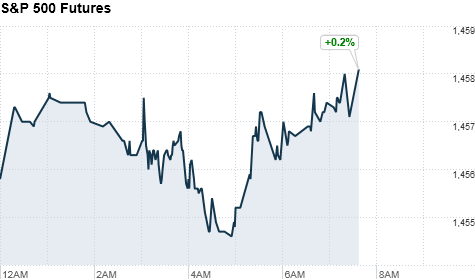
NEW YORK (CNNMoney) -- U.S. stock futures edged higher Friday as investors anxiously await the monthly U.S. jobs report.


The government's monthly report will be released at 8:30 a.m. ET. Analysts surveyed by CNNMoney forecast that employers added 110,000 jobs in September, only a slight improvement over the 96,000 jobs added in August.


That wouldn't be enough to noticeably change the unemployment rate, which is expected to remain at a high 8.1%.


Later in the day, the Federal Reserve will release data on August consumer credit, which is expected to have expanded by $5 billion, according to a survey of analysts by Briefing.com.


U.S. stocks finished higher Thursday after European Central Bank president Mario Draghi reiterated the central bank's commitment to its new bond-buying plan.


Fear & Greed Index


World Markets: European stocks were higher in morning trading. Britain's FTSE 100 rose 0.5%, the DAX in Germany added 0.8% and France's CAC 40 gained 1.2%.


Asian markets posted gains for the day. The Hang Seng in Hong Kong rose 0.5%, while Japan's Nikkei ended 0.4% higher. Markets in Shanghai were closed this week for a holiday.


Companies: Shares of social gaming firm Zynga (ZNGA) plunged 22% in premarket trading, following the company's announcement that it was lowering its 2012 guidance.


Facebook (FB) shares shed more than 2% in premarket trading, a day after company declared 1 billion people use Facebook.


Related: Behind Iran's currency crash


Currencies and commodities: The dollar rose against the euro and British pound and Japanese yen.


Oil for November delivery fell 68 cents to $91.03 a barrel.


Gold futures for December delivery dropped $3.30 to $1,793.20 an ounce.


Bonds: The price on the benchmark 10-year U.S. Treasury fell, pushing up the yield to 1.68% from 1.66% from late Thursday.


Source & Image : CNN Money

Election: Status quo would be stock market nightmare

Investors are watching the race for the White House like hawks because, when it comes to the fate of the fiscal cliff, there is a lot riding on the Nov. 6 election.


Given all the partisan bickering over how to solve the nation's growing debt, and more immediately, how to avoid the simultaneous onset of tax increases and spending cuts that will be triggered on Jan. 1, the worst possible outcome would be status quo in Washington, said BlackRock's iShares global chief investment strategist Russ Koesterich.


Related: Warning: Stock correction may be coming


"With a Republican sweep, investors can remove the risk of tax hikes, and with a Democratic sweep, there will also be an agreement that allows the economy to avoid the fiscal cliff," said Koesterich. "But with an Obama win, a Republican House and a Democratic Senate, there will just be more heated discussions and a greater likelihood that we will fall over the cliff."


The ramifications of political brinkmanship? Of 17 top economists surveyed  by CNNMoney, 14 believe that Washington's failure to address the fiscal cliff would cause the economy to tumble into a new recession. And that would throw financial markets in turmoil.


Related: Romney wins debate -- on Intrade


Though it wouldn't be pretty, Koesterich said the one bright spot with reaching the fiscal cliff would be the buying opportunity it would create in financial markets. But leading up to that point, Koesterich recommends a defensive approach. Socking money away in dividend-paying blue chip stocks would be among those safe defensive moves.


Though the fiscal cliff is a big risk for the market in the short-term, Koesterich notes that the election outcome won't have much of an impact on portfolios over the long-term.


"There's no historical evidence that proves a Democratic or Republican president is better for the stock market, or that divided government is good for the market," said Koesterich. "It's all a myth."


Source & Image : CNN Money

Behind Iran's currency crash


Iranian protesters scuffle with police in central Tehran in the first sign of public unrest over Iran's plunging currency. The rial lost more than half of its value since last week.


NEW YORK (CNNMoney) -- Iran's currency is in a free fall, and the sanctions over its nuclear program are mostly to blame.


Officially, the Iranian government offers to sell one U.S. dollar for about 12,500 Iranian rials. But it only offers that rate on a limited basis.


So Iranians, who need dollars to both buy imported goods and guard their savings against rampant inflation, have developed an extensive black market in dollars. It's on this market that the value of the rial has tumbled.


At the beginning of the year, rials on the black market were worth close to the official rate. But by late September, the rial had lost half its value, trading around 24,000 to the dollar.


In the last few days the currency has plummeted even further. Reports Wednesday said money changers in Tehran were charging 39,000 rial for a dollar -- a staggering 60% slide in a matter of days.


"This is one of the most intense episodes for the county in the last 100 years," said Gary Hufbauer, a senior fellow at the Peterson Institute for International Economics.


What sparked the rial's plunge


Most experts think the fall is a direct result of sanctions designed to get Iran to curtail its nuclear program, which Iranian leaders say is intended to generate nuclear power but many suspect could be used to produce a weapon.


The most recent rial plunge was sparked when the government said it would only offer the official exchange rate to importers of a few select items -- namely meat, grains and medicine. Importers who wanted to bring other consumer and industrial goods into the country -- most of which come from abroad -- would now be offered a rate from the government that is closer to the black market rate.


The move was an attempt to liberalize the currency market, squeeze the underworld traders and hopefully stabilize the frenzied rial.


Instead, it had the opposite effect.


By offering fewer dollars per rial, the Iranian government signaled to the people that it is trying to preserve the dollars it holds as foreign reserves -- in effect, preparing for a long bout with sanctions.


"It led to a loss of confidence among Iranians on the ability and willingness of the government to resolve the crisis," Behzad Yaghmaian, a professor of political economy at Ramapo College, told CNN.


Related: Iran arrests 16 in currency crisis


The sanctions, imposed largely by the U.S. and European Union, have cut Iran's oil exports in half. Oil exports are where Iran gets the majority of its dollars. Fewer dollars mean people are paying more rial to buy each one -- devaluing the rial. When the rial falls, the price of everything else goes up.


A popular bread called barbari -- which is made from imported wheat -- has gone from about 1,000 rials to about 5,000 rials. A local baker told CNN the cost will likely skyrocket further.


Feta cheese cost 50,000 rials per kilogram in March. The price has since tripled. Meat that cost up to 190,000 rials per kilogram then has doubled in price.


There are a few other explanations being floated for the sinking currency. Some Iranian officials have claimed black market traders were spreading rumors so they could profit off the rial's decline. Others say the Iranian government is restricting the flow of dollars into the economy so it can balance the budget on the back of a depressed rial.


But even Iranian President Mahmoud Ahmadinejad blames the sanctions. He said the currency drop is part of what he calls an economic war being waged against the country.


Whether the sanctions and resulting price spikes will be enough for the Iranian government to alter course on its nuclear program -- or to topple the government itself -- is another matter. So far Tehran has shown little interest in halting work on uranium enrichment capabilities that, if perfected, could quickly yield a bomb.


Analysts say the possibility of government reform remains remote.


Despite protests in Tehran Wednesday over the rial's fall, organized opposition to the government is weak, while the government's security apparatus is strong.


Plus, the country maintains populist programs designed to keep dissent at bay, including subsidized medicine, education and fuel.


"There has been no significant unrest during the rial's steep slide," Cliff Kupchan, a Middle East analyst at the Eurasia Group, wrote in a recent research note. "While this does not at all preclude future unrest, it suggests public tolerance for depreciation."


Source & Image : CNN Money

Fiscal cliff threatens 277,000 federal jobs


Some 277,000 federal workers, including meat inspectors, could lose jobs next year if Congress doesn't stop agency cuts that kick in Jan. 2.


WASHINGTON (CNNMoney) -- Federal workers have weathered a two-year pay freeze, increased health insurance premiums, and threats of more cuts from Republicans.


Now their jobs are in jeopardy. Some 277,000 workers -- 14% of the federal work force -- could lose their jobs in the next 12 months if the U.S. cannot avert the so-called fiscal cliff, according to a study by the Center for Regional Analysis at George Mason University.


If Congress doesn't act by Jan. 1, the U.S. will go over the fiscal cliff, triggering about $1.2 trillion worth of spending cuts over a decade.


The cuts could slice some 48,000 federal workers from civilian defense jobs and 229,000 from federal jobs.


No one knows exactly how the cuts would fall. The White House's Office of Management and Budget has released figures on how much is slated to be axed from each agency. But it has yet to identify programs at stake.


Jobs could be slashed from food inspections, health institutes, national parks and even air traffic control towers staffed by Federal Aviation Administration employees, said Stephen Fuller, director of the Center for Regional Analysis.


Fuller laid out the worst-case scenario of the spending cuts.


"What that means is some airports won't be able to land as many planes, because FAA controllers won't be in the towers," said Fuller, a public policy professor. "FBI agents won't be on the ground investigating and meat inspectors won't be inspecting."


When contacted, spokespersons from the U.S. Department of Agriculture, the Federal Aviation Administration, the FBI, and the National Park Service referred CNNMoney to the Office of Management and Budget for questions on fiscal cliff-related job cuts. The OMB declined comment.


Federal workers have been in the line of fire. House Republicans have held hearings questioning their pay and benefits. Last month, the president extended a two-year pay freeze on salaries through March.


In the presidential debates Wednesday night, Mitt Romney pledged that if elected he'd "cut back the number of employees, combine some agencies and departments," although he said the moves would be accomplished through attrition.


Related: Americans face $3,500 fiscal cliff tax hit


It's not just federal workers who are facing cuts.


If the fiscal cliff isn't averted, it will lead to job losses in the private sector too, which could push unemployment above 9% by the end of 2013, according to the Congressional Budget Office.


Despite employee fears, the Obama Administration is telling federal agencies, as well as private federal contractors, not to prepare for massive furloughs and layoffs.


The Administration is betting that Congress will beat the fiscal cliff deadline, even if it means kicking the can down the road, as lawmakers have done so many times before.


Federal workers have received little to no guidance about how to prepare for the fiscal cliff, except by some of their union leaders.


"I've been telling employees for the last year: You need to start putting something away just in case the worst case scenario happens," said Don Hale, a local president of the American Federation of Government Employees at the U.S. Military Academy West Point. He and others workers at West Point are among those whose civilian defense jobs are at stake.


"The problem with that is: It's hard for a (worker) at West Point making $12 an hour to put a way a nest egg."


Source & Image : CNN Money

Fact check: Obama isn't killing small banks

Since Dodd-Frank, small banks have grown more profitable.


Obama RomneyFORTUNE -- In Wednesday's presidential debate, Mitt Romney said President Obama was both the banking industry's make out partner and grim reaper. Neither were meant as a compliment.


In a response to a question about regulation, Romney said Dodd-Frank, the set of banking reforms that Obama pushed for and Congress passed in the wake of financial crisis, was an example of a law that's hurting the economy. Romney said that by specifying certain banks as Too Big to Fail, the government has given "the biggest kiss to New York banks I've ever seen." As a result, Romney said that's making it tough for smaller banks to compete.


"We need to get rid of that provision because it's killing regional and small banks," said Romney.


MORE: Romney and the 47%: Part of the same tax problem


Romney said 122 small and community banks have failed since the passage of Dodd-Frank. In fact, the mine field for small banks might be even worse than Romney describes. In the two years, since the passage of Dodd-Frank in mid-July 2010, 196 banks have failed, most of which would qualify as small or community banks.


But it's not clear that has anything to do with Dodd-Frank. In the two years leading up to Dodd-Frank, 256 banks failed, albeit at least part of that time includes a banking crisis, but many of the failures of the past two years have been related to the credit crunch as well. Most banks fail because they make bad loans, not because they are being run over by larger rivals.


What's more, Dodd-Frank doesn't appear to be giving the nation's mega banks any more of an advantage than they had before. The four biggest banks have increased lending slightly faster since Dodd-Frank than their smaller rivals, 4% vs. 1%, according to stats from Bankregdata.com. But loan growth for both groups has been slow.


MORE: Happy Birthday TARP: 4 years and counting


And the recent falling mortgage rates have disproportionally helped the big banks. But mortgage lending is an area in which the national banks have long dominated, well before Dodd-Frank. Take home loans away and the difference in lending growth is even smaller.


The argument that some people make is that designating the biggest banks as "systemically important financial institutions," as Dodd-Frank requires, makes it much cheaper for them to borrow, since no one thinks the government will allow them to fail. The result is higher profits and a big advantage that will allow the mega banks to run everyone else out of town.


But it doesn't appear to be turning out that way. According to the Federal Deposit Insurance Corporation's quarterly reports, the net interest margin, which is a measure of the difference between what it costs a bank to borrow and what it can lend its money out at, at the nation's 28 banks that have over $10 billion in assets has fallen since the passage of Dodd-Frank. The same figure at community banks has remained essentially unchanged, and is now higher for the small banks, meaning they're loans are more profitable, not less.


MORE: Maps aren't the only disaster in Apple's IOS 6


Another measure of profitability, return on equity, is up for the big banks by 24% since the passage of Dodd-Frank. But in the same time, the ROE of small banks has soared 223%.


Yes, being seen as too big to fail might lower borrowing costs, but Dodd-Frank imposes other limits on large banks, like higher capital requirements and more oversight, that will raise their costs as well. What's more, the government hasn't actually officially named what banks are systemically important. So any lovin' they have gotten so far is from the market, not Dodd-Frank, or Obama.


Small bank executives have bitterly complained about Dodd-Frank. (So have executives of larger banks, by the way. Jamie Dimon, we're looking at you.) One executive of a small bank in Texas is the lead plaintiff in a case that claims Dodd-Frank is unconstitutional.  But small banks are not complaining about the part of Dodd-Frank that has to do with their larger rivals. In fact, that's a part of the law they like. What competitor wouldn't?


Cam Fine, who heads up the Independent Community Bankers of America, which is the largest trade group for small banks, says he would have liked to see Dodd-Frank break up the big banks. He says he agrees with Romney that anything that codifies the policy that some banks are Too Big to Fail is a bad thing. But he's not sure Dodd-Frank does that. In all, he says he thinks Dodd-Frank is am improvement when it comes to the big banks. Imposing higher restrictions on the big banks, as Dodd-Frank does, Fine says is well intentioned and "good regulation."


"I think Dodd-Frank is a mixed bag," says Fine. "But the part that deals with big banks I was happy with."


Source & Image : CNN Money