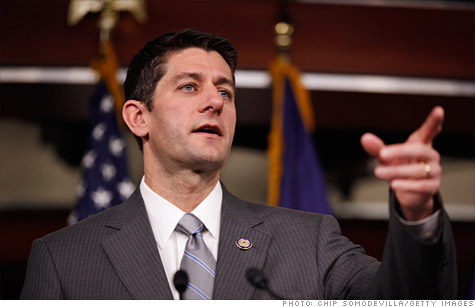
House Budget Chairman Paul Ryan proposed a $3.5 trillion budget for 2013 that would kill $55 billion in automatic defense cuts.
NEW YORK (CNNMoney) -- House Republicans on Tuesday made it official: They're proposing a $3.53 trillion budget for 2013 that would kill $55 billion in spending cuts aimed at defense and make up for them with savings elsewhere in the budget.
Overall, the plan from House Budget Chairman Paul Ryan would bring in $2.73 trillion in tax revenue in 2013, compared to $3.53 in outlays, leaving next year's deficit at just under $800 billion. After that point, annual deficits would fall significantly, reaching as low as $166 billion by 2018 but then begin to climb again.
As a share of the economy, Ryan estimates that his budget would leave the debt held by the public at 62.3% of GDP, down from about 73% this year.
The Congressional Budget Office, the official arbiter of legislative costs, has yet to release an analysis of the Republican proposal.
The Ryan budget, coming in an election year when Congress is not expected to make major progress on fiscal policy, is as much a statement of party priorities as anything else. As such, it's light on details but heavy on promises.
Part of the budget calls for major tax reform, but that's a relative sideshow to where the Republicans come down on spending issues.
Democrats have urged Republicans not to cap spending at less than the $1.047 trillion level agreed to in last summer's bipartisan budget deal.
But Republicans have said that number was a ceiling, not a level up to which Congress must spend. And, they add, once the so-called "sequester" of automatic spending cuts required under the 2011 Budget Control Act kick in, the effective spending cap for 2013 is closer to $950 billion.
The GOP, in its budget document Tuesday, is assuming a 2013 discretionary spending cap of $1.028 trillion. And it appears they arrive at a net spending number of roughly $950 billion after making various cuts, as would be the case if the cap had been left at $1.047 trillion.
In explaining the decision to cancel the automatic defense cuts, Ryan said the $55 billion in reductions called for under the Budget Control Act would be "devastating to America's defense capabilities."
Instead, the Ryan budget calls on appropriators to find savings in other areas. Among its proposals: make federal worker pensions more like those in the private sector, means-test entitlement benefits, and push through medical tort reform.
Another controversial proposal is Ryan's call for significant changes to Medicare. His plan resembles one he put out last year with Ron Wyden, a liberal Democratic senator.
The Ryan-Widen proposal would offer future seniors a choice of staying in the traditional fee-for-service Medicare plan or opting for a Medicare-approved private plan, all of which would be available via a new Medicare exchange.
No matter which plan they chose, including the traditional Medicare plan, seniors would receive a government subsidy to help pay for their choice.
--CNN's Deirdre Walsh and Lisa Desjardins contributed to this report.

No comments:
Post a Comment